
Bollards for Daycares and Schools: Why Child Safety Starts at the Curb
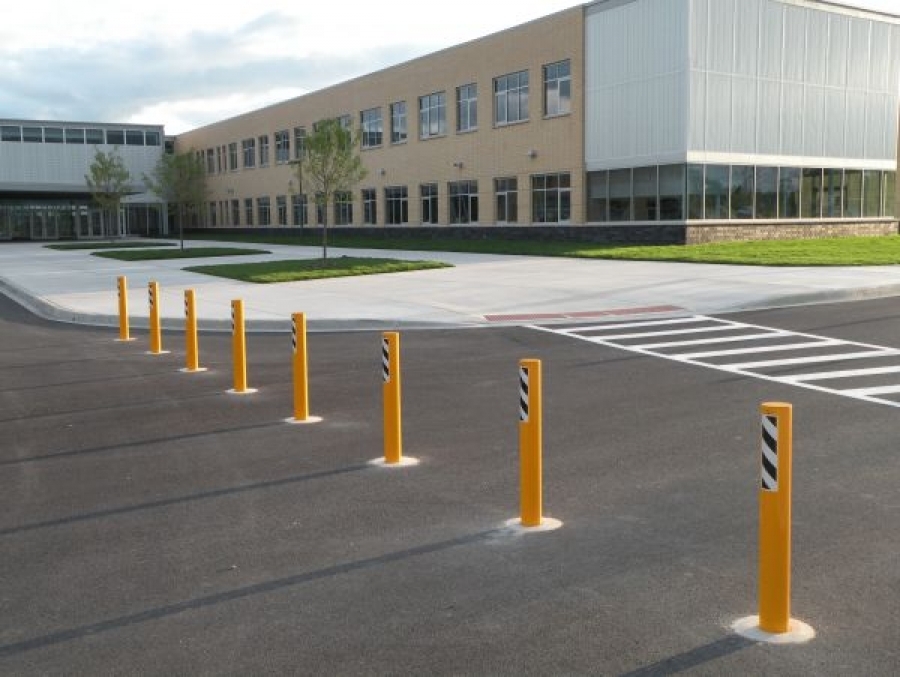
Every daycare operator and school administrator thinks about child safety. Fire drills, emergency procedures, supervision ratios — these things are built into how facilities are run. But one risk that often goes unaddressed is right out front: the drop-off zone.
Vehicles and young children in close proximity are a serious hazard. Parking lots, driveways, and drop-off areas are some of the most dangerous spaces a child encounters daily, and a single moment of driver error can have devastating consequences. Bollards are one of the simplest and most effective tools for reducing that risk.
The Drop-Off Zone Problem
Drop-off zones at daycares and schools are inherently busy and chaotic. Parents are distracted. Children are unpredictable. Vehicles are moving in multiple directions. And in many cases, the physical layout of the facility offers very little separation between moving vehicles and the areas where children gather.
Without a physical barrier, the only thing standing between a child and an errant vehicle is luck. That’s not a safety plan.
Bollards change that. A properly placed row of bollards in front of an entrance, along a walkway, or at the edge of a play area creates a physical boundary that vehicles simply cannot cross. It doesn’t rely on signage, painted lines, or drivers paying attention. It works regardless.
Where Bollards Make the Biggest Difference at Child Care Facilities
Main entrance and front door. This is the highest-risk zone at most facilities. Children are arriving and departing, often moving between a parked vehicle and the front door in an unsupervised or partially supervised moment. Bollards along the building frontage protect that path.
Drop-off lanes. A designated drop-off lane that isn’t physically separated from pedestrian areas is a safety gap. Bollards can define the edge of the lane and prevent vehicles from straying into the pedestrian zone.
Outdoor play areas. Play areas that sit close to a parking lot or driveway benefit significantly from bollard protection. Children playing outside are not watching for vehicles, and drivers often don’t expect children to be near the edge of a play space.
Side and rear entrances. Facilities with multiple entry points sometimes focus safety measures on the front and leave secondary entrances less protected. These are worth assessing too.
Which Type of Bollard Works Best
For most daycare and school applications, fixed bollards are the right choice. They’re permanently anchored, highly visible, and require no action from staff to be effective. They’re there all the time, which is exactly what you want in a child safety context.
Removable bollards may be appropriate for areas that occasionally need vehicle access, like a rear entrance used for deliveries or maintenance. Staff can remove them when access is needed and reinstall them when it isn’t.
Automatic retractable bollards are a good fit for facilities that need to manage authorized vehicle access at a specific point without requiring manual effort from staff. These are more common in larger institutional settings.
For facilities looking to browse product options, Bollard Boys offers a full range at bollardboys.com, including fixed bollards and removable bollards suited to child care environments.
What the Research Says
Vehicle incidents in school and daycare drop-off zones are not rare. Studies from the Parachute Canada injury prevention organization consistently identify parking lots and drop-off areas as high-risk zones for child pedestrian injuries. Most incidents involve vehicles moving at low speeds, which means the driver didn’t intend to cause harm. Physical barriers like bollards address the problem regardless of driver intent.
Regulatory Considerations
In Ontario, licensed child care centres are governed by the Child Care and Early Years Act, which includes requirements around the safety of the physical environment. While the Act doesn’t prescribe specific security hardware, operators have a duty to maintain a safe environment, and a documented assessment of vehicle access risks is increasingly part of how facilities demonstrate compliance.
Installing bollards is a visible, defensible step that shows regulators, parents, and insurers that the facility takes vehicle safety seriously.
The Conversation Worth Having
If you operate a daycare or manage a school facility in the GTA and you haven’t assessed the vehicle access risks around your building, it’s worth doing. A professional bollard installer can walk the site with you, identify the highest-risk points, and recommend a setup that fits your layout and budget.
Bollard Boys GTA specializes in daycare bollard installations across the Greater Toronto Area, working with facility operators to design and install protection that fits the specific needs of child care environments.
Protecting the children in your care starts before they walk through the door. Contact Bollard Boys GTA to book a site assessment for your daycare or school facility.