
Retractable vs. Removable Bollards: What's the Difference and Which Should You Choose?
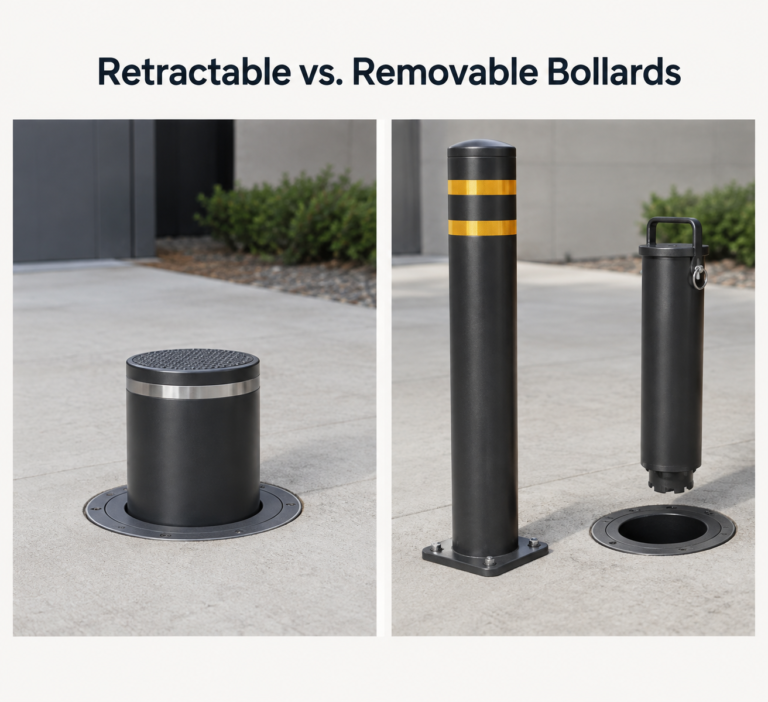
If you’ve been researching bollards for more than ten minutes, you’ve probably run into the terms “retractable” and “removable” and started to wonder whether they mean the same thing. They don’t, and the difference matters when you’re trying to figure out which one actually fits your situation.
Here’s a plain-language breakdown of how each type works, where each one makes sense, and what to consider before choosing.
How Removable Bollards Work
A removable bollard is exactly what it sounds like. The post sits inside a ground sleeve that’s permanently anchored in concrete. When you need to block vehicle access, the bollard is in the sleeve. When you need to allow a vehicle through, you unlock the bollard at the base and physically lift it out of the sleeve, then store it somewhere nearby.
The process is manual. You’re physically carrying the bollard each time. Most removable bollards are designed to be manageable for one person, but they do weigh several kilograms, and the process of lifting, storing, and reinstalling them every time adds up if you’re doing it frequently.
The sleeve stays in the ground when the bollard is removed, and vehicles drive over it without issue because it sits flush with the surface.
How Retractable Bollards Work
A retractable bollard doesn’t come out of the ground. Instead, it collapses down into its housing sleeve so that it sits flush or near-flush with the surface, allowing vehicles to drive over it. When you need to block access, the bollard rises back up into its full height.
Most retractable bollards are operated with a key mechanism at the base. You insert the key, turn it, and the post either rises or drops, depending on where it’s starting from. No lifting, no storage, no carrying.
Some retractable systems include a gas-assist or spring mechanism that makes raising and lowering the post easier. Automatic retractable bollards take this further, allowing the bollard to be raised and lowered remotely without any manual interaction at all. These are a separate category and worth their own consideration for high-use applications.
The Key Differences Side by Side
Manual effort. Removable bollards require you to lift the post out entirely and carry it somewhere. Retractable bollards require only a key turn. If you’re managing access multiple times a day, retractable is significantly more convenient.
Storage. With a removable bollard, you need somewhere to put the post when it’s not in the sleeve. That could be a bracket on a nearby wall, a rack, or simply leaning it somewhere out of the way. Retractable bollards have no storage requirement because the post stays in the ground.
Security when down. A removable bollard that’s been taken out of its sleeve leaves the sleeve exposed but creates no barrier. A retractable bollard that’s been lowered sits flush with the ground and allows vehicles to pass, but the post itself is still in the housing and can be raised again quickly.
Cost. Removable bollards are typically the more affordable entry point. The hardware is simpler, and the installation is straightforward. Retractable bollards cost a bit more because the mechanism is more engineered, but the gap isn’t enormous for manual retractable systems.
Installation. Both require a ground sleeve and concrete footing. The installation process is similar in scope, though retractable bollards with more complex mechanisms may require slightly more precise installation to ensure the post rises and lowers smoothly over time.
When Removable Makes More Sense
Removable bollards are a good fit when:
- Access needs are infrequent. If you’re unlocking the space once or twice a week for deliveries, the manual effort is manageable.
- Budget is a primary consideration. Removable systems are the most cost-effective way to get flexible access control.
- The property doesn’t have a convenient place to set up a retractable mechanism or the installation conditions favour a simpler setup.
When Retractable Makes More Sense
Retractable bollards are the better choice when:
- You need to manage access regularly, daily or multiple times a week, and you don’t want the hassle of lifting and storing the post each time.
- There’s no convenient storage location for a removed bollard near the installation point.
- The bollard is being used in a commercial setting where ease of operation for staff matters.
- You want the option to upgrade to an automatic system later, since many retractable bollard sleeves are compatible with automatic drive mechanisms.
What About Automatic Bollards?
Automatic bollards are a type of retractable bollard with a motorized or hydraulic mechanism that raises and lowers the post on demand, typically via remote, keypad, or key switch. They remove the manual step entirely and are the preferred option for high-frequency access applications. You can explore the automatic bollard range at bollardboys.com if that sounds like a better fit for your needs.
For a full comparison of all bollard types, including retractable bollards and removable bollards, the Bollard Boys product catalogue is a good starting point.
The Bottom Line
If you need access control that you’ll manage regularly and convenience matters, go retractable. If access needs are occasional and you want the most cost-effective solution, removable is perfectly capable. And if daily hands-free access control is the goal, automatic is worth the additional investment.
Not sure which one fits your property? Bollard Boys GTA can assess your setup and make a recommendation based on your specific access needs and site conditions.
Bollard Boys GTA supplies and installs removable, retractable, and automatic bollards for residential and commercial properties across the Greater Toronto Area. Get a free quote or contact us to talk through your options.