
What Are Crash Rated Bollards and Does Your Property Need Them?
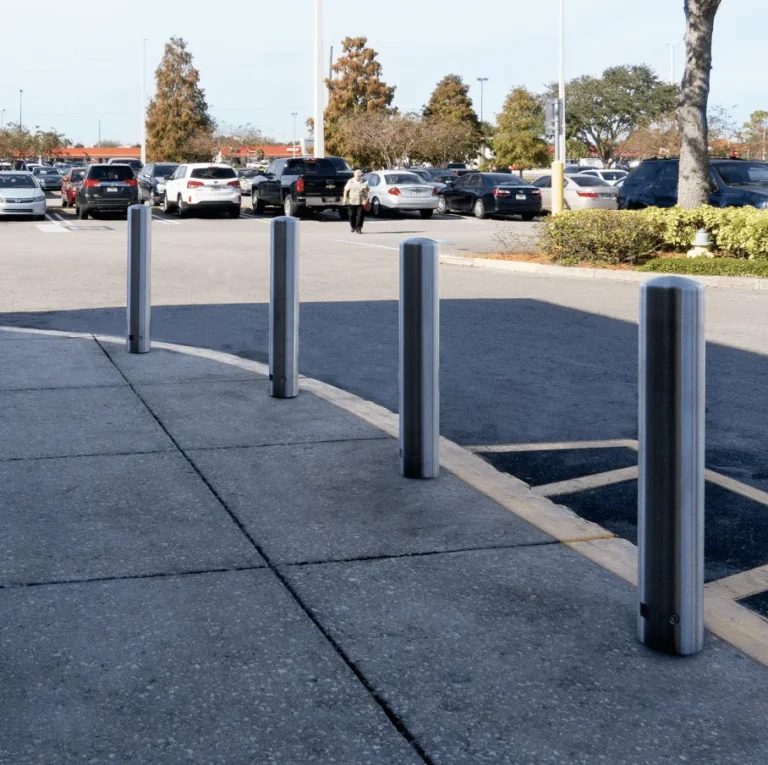
Not all bollards are created equal. A decorative bollard at the edge of a sidewalk and a crash rated bollard outside a government building might look similar from the outside, but they perform very differently when it comes to stopping a vehicle.
If you’ve started researching bollards for a commercial or institutional property, you’ve probably come across the term “crash rated.” Here’s what it actually means and how to know whether it applies to your situation.
What Makes a Bollard Crash Rated
A crash rated bollard is one that has been independently tested to verify it can stop a vehicle of a specific weight traveling at a specific speed. The testing is done under controlled conditions where a vehicle is driven into the bollard at the rated speed, and the bollard is evaluated on whether it stopped the vehicle and how far the vehicle penetrated past the barrier point.
The result is a certification that tells you, with real data behind it, what the bollard can actually handle. That’s different from a manufacturer simply saying a product is “heavy duty” or “high security.”
How the Ratings Work
The most widely referenced standard for bollard crash testing in North America is ASTM F2656. Under this standard, bollards are rated based on the speed of a test vehicle and the distance it penetrates after impact.
For example, a bollard rated M30 P1 means it was tested against a 15,000 pound vehicle traveling at 30 mph and stopped it within 3.3 feet of the barrier line. Higher ratings reflect higher vehicle weights, higher speeds, or tighter penetration limits.
There are also international standards, including PAS 68, which is commonly referenced in the UK, so if you’re working with a supplier that cites a different certification, it’s worth understanding what testing that standard requires.
Where Crash-Rated Bollards Are Typically Required
Crash-rated bollards are most commonly specified for:
- Government buildings and embassies
- Critical infrastructure, including utilities and transit facilities
- Financial institutions and data centres
- Airports and transportation hubs
- Crowded public spaces, including event venues and pedestrian plazas
- High-value retail or corporate campuses with elevated security requirements
In many of these settings, crash ratings aren’t optional. They’re a requirement set by the building owner, a government standard, or an insurer.
Does a Standard Commercial Property Need Them
For most retail businesses, office buildings, and commercial properties, standard heavy-duty bollards provide adequate protection. The risk profile simply doesn’t require a bollard that’s been certified to stop a 15,000-pound vehicle at high speed.
Crash-rated bollards become relevant for a more typical commercial property when the risk is elevated, either because of the nature of the business, the location, or a specific security assessment that identifies vehicle-borne threats as a significant concern.
If you’re not sure whether your property warrants crash-rated protection, it’s worth having a conversation with a security consultant or an experienced bollard installer who can assess your specific situation.
What to Expect Cost-Wise
Crash-rated bollards are more expensive than standard commercial bollards, both for the product and the installation. The added cost reflects the engineering and materials required to pass the testing standards. Installation also tends to be more involved, with deeper footings and more substantial concrete work required to make sure the bollard performs as certified.
For properties where this level of protection is needed, the cost is simply part of the security investment. For properties where it isn’t, spending on crash ratings where standard bollards would do the job is usually unnecessary.
Bollard Boys GTA helps property owners choose the right level of protection for their specific situation. Get in touch to talk through your security needs.