
What Happens If a Vehicle Drives Into Your Storefront? Who Is Liable in Ontario?
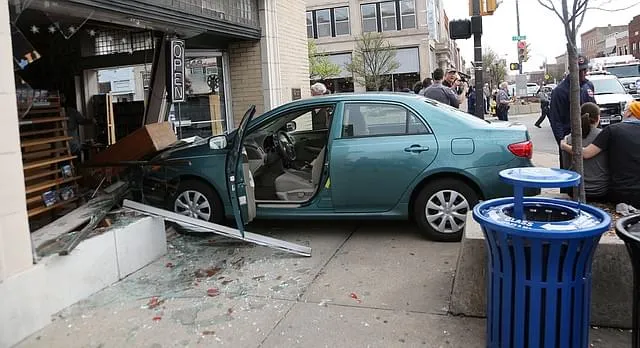
It happens more often than most business owners realize. A driver hits the gas instead of the brake, loses control in a parking lot, or deliberately rams a storefront. In seconds, your business has a collapsed entrance, injured customers, and a legal situation that could take years to sort out.
If you own or operate a commercial property in Ontario, understanding how liability works in these situations is not optional. The answer is more complicated than most people expect, and in some cases, part of that liability can land squarely on you.
First: Who Is Liable When a Vehicle Hits a Storefront?
The short answer is that multiple parties can share liability depending on the circumstances. Ontario law does not automatically pin the entire outcome on the driver.
The driver is typically the first party examined. If their negligence caused the crash, whether through distracted driving, speeding in a parking lot, a medical episode, or an intentional act like a ram raid, they carry primary fault. Their auto insurance would be the first line of financial response.
The vehicle owner can also be held responsible if the driver had their permission to use the vehicle. Ontario legislation establishes that vehicle owners are responsible for the acts and omissions of those to whom they lend their vehicles, even indirectly through a chain of consent. If a company vehicle was involved and the driver was working at the time, the employer may also face liability.
The property owner and/or occupier is where it gets important for business owners. Under Ontario’s Occupiers’ Liability Act, property owners, tenants, and managers have a legal obligation to keep visitors safe on their property. This duty of care applies not just to slip and fall hazards but to foreseeable risks of any kind, including vehicle impact.
When Can a Business Owner Be Found Liable for a Vehicle Crash?
This is the question most commercial property owners don’t think to ask. The answer depends on foreseeability.
Ontario courts look at whether a reasonable occupier in your position should have anticipated the risk and taken steps to prevent it. Legal experts and personal injury lawyers have noted that where prior storefront crashes have occurred, or where a crash could reasonably be expected given the layout of a property, the store operator and building owner may share responsibility for resulting injuries and losses.
In practical terms, this means that if your storefront is adjacent to a busy parking lot, located near a drive-through lane, sits close to a road with high traffic volume, or is in an area where similar incidents have occurred nearby, a court could find that installing vehicle barriers was a reasonable precaution you should have taken.
The foreseeability argument has teeth. Vehicle-into-building incidents are not rare events. In the United States, the Storefront Safety Council estimates that a vehicle crashes into a commercial building nearly 60 times per day, and similar patterns exist in Canada. When something happens that frequently, it becomes harder to argue you could not have seen it coming.
What About Ram Raids?
Intentional ram raids, where thieves use a vehicle to breach a storefront and steal merchandise, add another layer of complexity. In these cases the driver’s criminal liability is clear, but recovery of damages from a fleeing criminal is often impossible in practice.
This puts the financial burden directly on the business owner’s commercial property insurance, and raises the same occupiers’ liability question: could a reasonable business owner in your position have installed vehicle barriers to prevent foreseeable criminal vehicle attacks? For pharmacies, cannabis retailers, convenience stores, and jewellers in Ontario, which are among the most frequently targeted categories, that question is increasingly hard to avoid.
What Does This Mean for Your Insurance?
Your commercial property insurance may cover structural damage to your building following a vehicle impact, but coverage varies significantly by policy. What insurance rarely covers fully is the liability exposure if a customer, employee, or passerby is injured in the incident and decides to pursue a claim against you as occupier.
Under the Occupiers’ Liability Act, both owners and occupiers of a premises can be liable for injuries caused by unsafe conditions, even when the initial danger was caused by a third party. That means if a customer is hurt when a vehicle comes through your storefront and a court determines you should have had a vehicle barrier in place, your insurer may not fully protect you.
The standard of care under the Act requires you to take reasonable steps to ensure visitors are safe. Installing a bollard in front of a storefront that faces a parking lot is, increasingly, what a reasonable occupier is expected to do.
The Practical Takeaway
No blog post replaces legal advice, and if you are facing a specific liability situation you should speak with an Ontario lawyer. But the general picture is clear: when a vehicle hits a commercial property in Ontario, liability does not stop with the driver. Property owners and occupiers who have not taken reasonable precautions against foreseeable vehicle impacts can and do face legal exposure.
A commercial bollard installation is not just a security measure. In many cases it is the documented evidence that you took your duty of care seriously.
What a Commercial Bollard Installation Actually Looks Like
Commercial bollards are not one-size-fits-all, and the right solution depends on your property, your tenant mix, and how your space is used day to day.
Fixed bollards are permanently set into the ground and offer the highest level of impact resistance. They are ideal for storefronts that do not need vehicle access at any point, such as the front facade of a pharmacy, a jewellery store, or a cannabis retailer. Once installed they require no maintenance and are essentially permanent protection.
Removable bollards can be lifted out of their ground sleeve when access is needed and locked back in place when it is not. These work well for businesses that occasionally need to allow vehicle access to a certain area, such as a loading zone that doubles as pedestrian space after hours, or a patio that needs to be set up and taken down seasonally.
Retractable and automatic bollards can be raised and lowered mechanically, either manually or with a key switch or remote. These are common in higher-traffic commercial environments like parking garage entrances, plaza driveways, or secured lots where vehicles need to enter and exit regularly but access still needs to be controlled.
The placement of bollards matters as much as the type. A professional installation accounts for the angle of approach from the parking lot, the distance from the storefront, the depth and composition of the surface being drilled into, and the spacing between posts. Too far apart and a vehicle can still get through. Too close together and you create an accessibility issue for customers with mobility aids, which has its own implications under the Accessibility for Ontarians with Disabilities Act.
Getting the specification right is not something to guess at. A bollard that is improperly installed, too shallow, or placed incorrectly may look like protection while providing very little of it. For commercial properties especially, where the liability stakes are higher and the traffic volumes are greater, professional installation is not optional.
Bollard Boys GTA installs commercial bollards across Toronto and the GTA, from retail storefronts and plazas to pharmacies, restaurants, daycares, and office buildings. We assess your property, recommend the right bollard type and placement, and handle the full installation. Contact us today for a free quote and protect your property, your customers, and your business.